What is tablet coating process?

Tablet coating is one of the commonly used pharmaceutical processes. This coating process can be applied by coating. The method can apply a substantially dry outer coating material to the surface of the dosage form to impart a particular benefit to the uncoated variety. It involves applying a sugar or polymer coating to the tablet.

Coating is an important part of the tablet production process. How to do the coating work directly affects the quality of the coated tablets.

Tablet coating process:

The auxiliary materials required for tablet coating are sucrose, talc, gelatin, and pigment. The amount of talc powder can reach more than 50% of the weight of the core.

There are six steps in general tablet coating:

1. In order to prevent the tablet core from being damaged due to the occurrence of rotten film during the rolling process of the sugar coating pan, thus the tablet quality affected, it is necessary to apply 2-3 layers of powder coating layer to increase core hardness and wear resistance.

2. The barrier layer prevents physical or chemical degradation of the active ingredient in the core by moisture attack.

3. The powder coating layer is rolled into a desired shape and size with 2% gelatin syrup and talc powder.

4. The sugar coating layer is a single syrup.

5. The colored layer uses colored syrup.

6. Finally, polish or wax is used to achieve a bright luster and prevent the ingress of humid air.

The tablet coating machine is a machine for uniformly coating and polishing the formed chips for the pharmaceutical industry, and can also be used for the candy mechanism pills or coatings in the food industry. The coated tablet has a bright and shiny surface, and the surface of the powdered sugar crystallizes to form a complete consolidated coating, which can also prevent the tablet chip from oxidative deterioration, moisture or volatilization, and can cover the chip to take discomfort. The taste is easy to identify and aid in the dissolution of the human stomach and in the stomach.

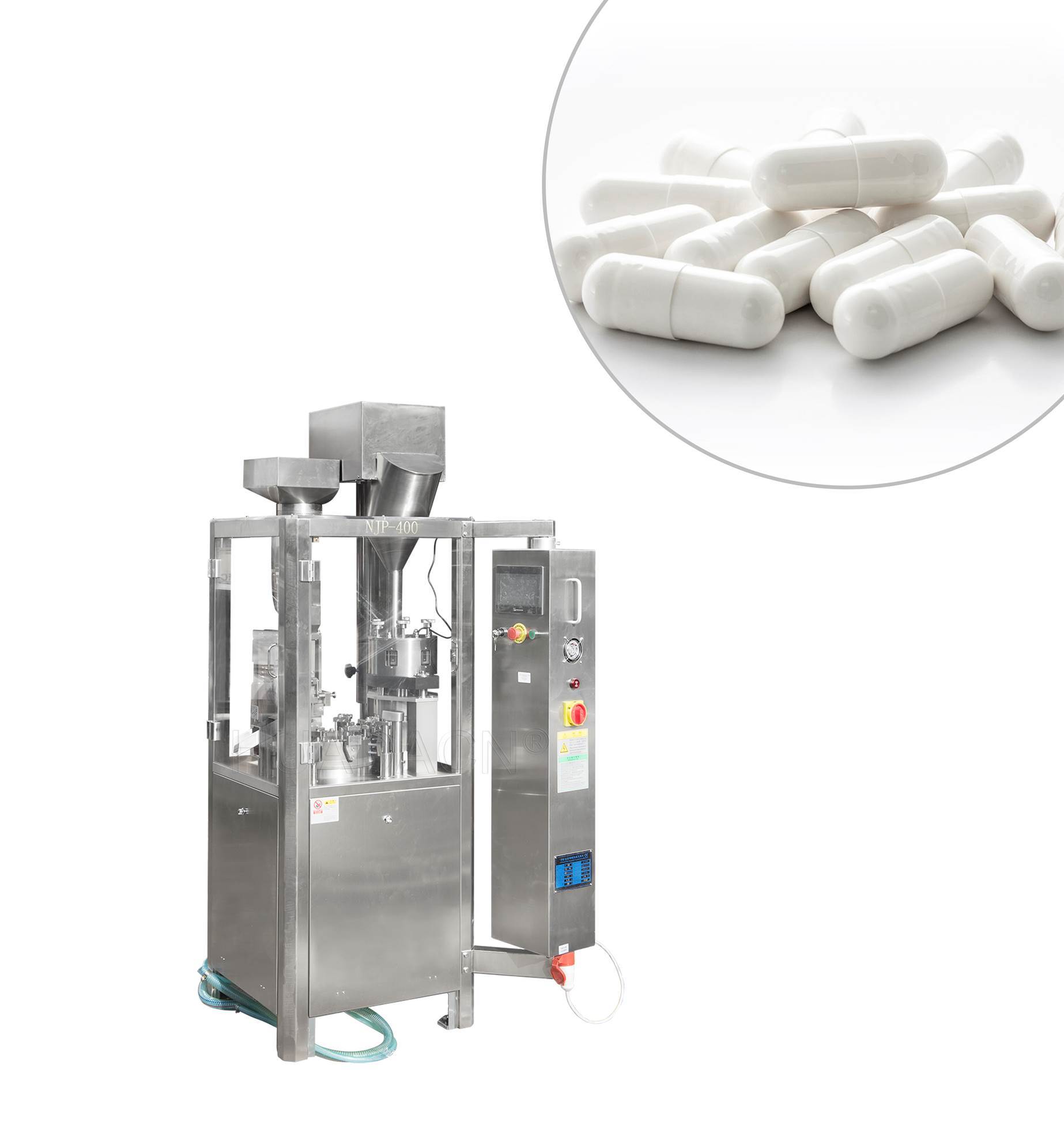
What are the differences between manual and automatic capsule filling, as well as various advantages and disadvantages?

Manual capsule filling machines are generally suitable for users with small capsules, such as homes and small clinics. The automatic filling machine has a high degree of automation and a relatively high cost, which is suitable for capsule production of large enterprises.

Unlike automatic filling machines, the powder of manual filling machines is manufactured in volume. This means that the entire capsule must be filled. Changes in API or final mixing density may make it impossible to fill the exact mixture. In the case of lower density, a manual compaction system can be used.

When using a manual capsule filling machine, attention must be paid to the formability of the filling powder, and a corresponding amount of powder can be manually placed in the capsule shell. If there is a filling capsule machine, if it is easy to form, a slight pressure can be applied to the corresponding filling rod of the root. Usually it is easy to fill.

Clearly, the main advantage of manually filling capsules is that the investment in equipment and format is much lower and the time for adjustment and cleaning related activities is greatly reduced. Another advantage of manual filling is the flexible volume, which makes it possible to package all powders, which is very useful for preparing very small batches in clinical trials or formulation tests.

Speed, reliability and ability to adjust doses are the main advantages of automated machines. The main drawbacks include the need to invest in expensive equipment and the time required to adjust the batch, which is more suitable for making larger batches than manual filling.

Capsule filling is a complex process, so there may be many challenges. It is important that the product to be packaged is well developed with acceptable flowability and repeatable batch-to-batch density to avoid problems with quality uniformity.

Reference: “Key Considerations in Capsule Filling,” Pharmaceutical Technology 41 (3) p. 30–34, 2017.

What are separated capsule and joined capsule?

The joined capsule refers to a capsule of which the capsule body and the capsule cap are pre-locked, and all capsule manufacturers can supply joined capsules, and most of the filling machines on the market are applicable to joined capsules.

The separated capsule refers to a capsule of which the capsule body and the capsule cap are separated. CapsulCN is the first manufacturer to offer separated capsule, and now many other manufacturers also have separated capsules.

Which type of capsule should I choose?

You’d better choose your capsule type according to the filling method you choose.

  • If you want to fill it manually, separated capsule is more convenient than the joined capsule, because you don’t need to separate the cap and body of the capsule before filling.
  • If you are going to use the manual capsule filler, separated capsule has more choices than the joined capsule. Some manual capsule fillers can only be filled with separated capsule, not the joined capsule, and these manual capsule fillers are much cheaper than the one can fill joined capsule.
  • If you are going to use an automatic capsule machine, then you’d better choose joined capsules, because almost all machines on the market are designed according to joined capsules.

You could find out more contents about filling of these two capsules in the Capsule Filler Selection Guide – How to fill the capsule with powder.

More informtion about capsules, please visit our website: www.capsulcn.com